From Theory to Practice: How to Build AI Agents
AI adoption is happening fast. Many leaders across industries are finding new and creative ways to integrate AI agents...


|
AI & DATA STRATEGY
|
 |
|
Synaptiq helps you develop your AI and data strategy as well as accelerate your roadmap to achieve successful business outcomes. Assess your AI and data readiness so you can prioritize the gaps you need to fill.
|
| Read More ⇢ |
|
DATA LAKE
|
 |
|
Synaptiq helps you unify structured and unstructured data into a secure, compliant data lake that powers AI, advanced analytics and real-time decision-making across your business.
|
| Read More ⇢ |
|
AI AGENTS & CHATBOTS
|
 |
|
Synaptiq helps you create AI agents and chatbots that leverage your proprietary data to automate tasks, improve efficiency, and deliver reliable answers within your workflows.
|
| Read More ⇢ |
|
LEGAL SERVICES
|
 |
|
Learn how Synaptiq helped a law firm cut down on administrative hours during a document migration project.
|
| Read the Case Study ⇢ |
|
GOVERNMENT/LEGAL SERVICES
|
 |
|
Learn how Synaptiq helped a government law firm build an AI product to streamline client experiences.
|
| Read the Case Study ⇢ |
 |
|
Mushrooms, Goats, and Machine Learning: What do they all have in common? You may never know unless you get started exploring the fundamentals of Machine Learning with Dr. Tim Oates, Synaptiq's Chief Data Scientist. You can read and visualize his new book in Python, tinker with inputs, and practice machine learning techniques for free. |
| Start Chapter 1 Now ⇢ |


In Part 1 of this series, I covered how the primary constraint on AI-driven performance isn't technology; it's the organization surrounding it. Role silos are dissolving faster than job descriptions are being rewritten. The workforce now includes autonomous AI systems that your org chart still shows as empty space. And the governance frameworks HR built for human workforces don't translate cleanly to systems that operate around the clock without judgment constraints. The organizational foundation is cracking not because anyone built it badly, but because the climate it was designed for no longer exists.
This article is about modernizing your organization, starting with the underlying capability to operate in an AI-accelerated environment. Without that foundation, you can redesign career paths, run 90-day activation sprints, and restructure hiring criteria, but all of it will still stall.
The Betterworks 2026 survey of nearly 2,400 employees makes the gap uncomfortably clear: 85% of HR leaders believe employees already receive adequate AI training, yet only 16% of employees use AI regularly in their daily work, and 58% of individual contributors say it hasn't improved their work at all. That's not a training volume problem: organizations are running programs, ticking boxes, and reporting completion rates. There is a training design problem, and fixing it requires thinking about workforce capability the way a forest ecologist thinks about a healthy ecosystem: in layers, each one creating the conditions that make the next layer possible.
Most organizations have AI training by now: a lunch and learn, online training, maybe a two-day workshop. Yet, training programs alone don’t change behavior. You will know AI has been adopted when you see it showing up in everyday work.
Think about how a forest develops. It doesn't grow uniformly from the top down. It develops in layers, each one creating the conditions that make the next layer possible. The canopy captures the most light and shapes the environment below it. The next level adapts to what the canopy allows and so on. AI literacy inside an organization works exactly the same way, and trying to build it once as a single program for everyone is the equivalent of planting only canopy trees and wondering why nothing else grows.
Let’s take a closer look at this multi-level literacy framework:
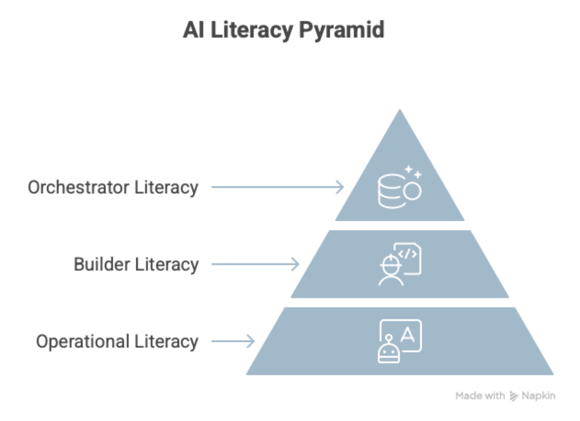
Layer 1: Operational Literacy (every knowledge worker) Every person in the organization should be able to:
Use AI for research, synthesis, and drafting
Automate their own routine administrative tasks
Reduce the cognitive overhead of work that doesn't actually require their judgment
This is about reclaiming hours that are currently being spent on work AI can handle, so people can spend more time on work only they can do.
Layer 2: Builder Literacy (operational innovators) These are the people who see the workflow problems clearly. The operations manager who knows exactly where the process breaks. The finance analyst who has rebuilt the same spreadsheet seventeen times. They now have the tools to fix these problems themselves without waiting six months for an engineering sprint. This layer should be prototyping and testing internal tools and workflow automations without help from developers.
Layer 3: Orchestrator Literacy (leadership) Leaders need to govern AI deployment without restricting it while connecting AI initiatives to business outcomes rather than IT projects that someone else owns.
The practical implication for HR is straightforward. Define what each layer looks like in your specific organization, tie progression through these layers to performance reviews, and measure outcomes in productivity terms, not course completion rates.
Furthermore, AI literacy programs fail when the tools aren't there, and the tools fail when policies aren't there. HR can design the most thoughtful capability framework imaginable, and it will still stall if IT hasn't provided secure, scalable, and affordable tools that are accessible for daily work. This might be Microsoft Copilot, a proprietary AI environment built on the organization's own data, or something else entirely. And those tools will create as many problems as they solve if HR hasn't put usage policies in place that tell people what they can and can't do with them safely. The literacy framework described above assumes HR and IT are building this together: HR owning the capability architecture, IT owning the tooling, data infrastructure, and productionalizing and supporting custom solutions for enterprise use. Together they own governance that makes it safe enough to use at scale. Without that partnership, you're asking people to develop skills they have no secure environment to practice in, which is equivalent to teaching someone to swim without ever letting them near water.
Traditional career progression rewards specialization, tenure, and the gradual accumulation of managerial responsibility over a growing headcount. The legacy model assumes that more value requires more people. But when an individual can use generative tools to do the work of a cross-functional team, value changes from managing headcount to the capacity to build and evolve the systems that drive results.
Traditional career progression is a ladder built for a stable climate. While performance reviews often recognize "process improvement," they are still largely anchored to narrow functional lanes. We reward a marketing specialist for being a better marketer, but we lack the mechanism to reward them for behaving like a cross-functional architect.
When an employee uses AI to collapse a three-day process into four minutes, they haven't just "simplified a task," they have fundamentally altered the organization's technical and operational infrastructure. They are operating in the "white space" between departments where traditional HR filters don't reach. To truly capture this value, promotion criteria must move beyond functional mastery and prioritize the ability to eliminate cross-functional friction and build integrated systems.
Future advancement signals must shift. Promotion criteria need to heavily weight:
Cross-Functional Integration: The ability to collapse the "white space" between departments by building shared automated systems.
Operational Bridge-Building: Acting as a high-level liaison between domain expertise and technical execution to solve organization-wide friction.
Systemic Influence: Moving beyond functional mastery to deploy internal tools that empower multiple teams, not just a single silo.
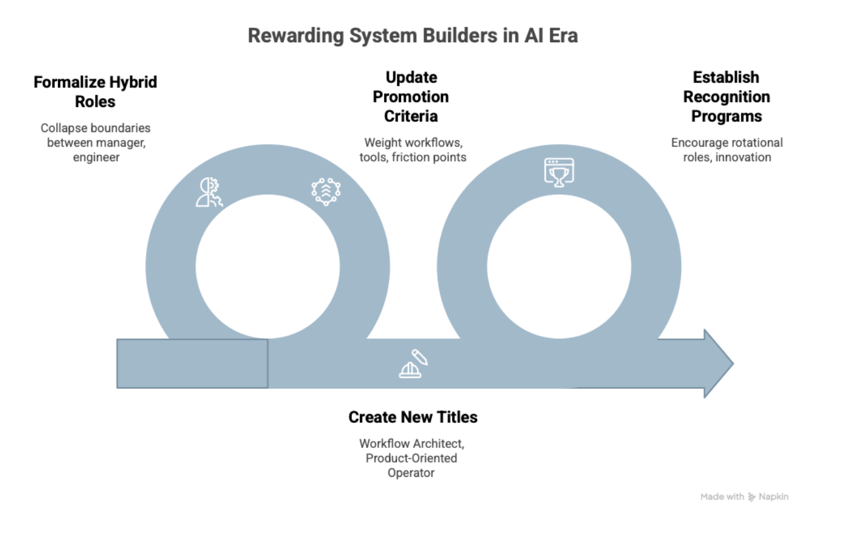
Organizations must begin formalizing hybrid roles that reflect this new reality. Consider what becomes possible when the historical boundaries between manager, engineer, and quality assurance collapse.
In a hyper-adaptive organization, a single operator equipped with generative tools can move from a blank page to a production-ready internal product in a matter of weeks. What once required a multi-quarter roadmap and a full cross-functional team is now achievable in a single focused sprint.
That is a feat that traditionally required an entire cross-functional team. To encourage this, HR needs to create titles and compensation bands for emerging roles like:
Workflow Architect: Designs and maintains automated operational systems across departmental lines.
Product-Oriented Operator: Combines deep domain expertise with the ability to independently build internal tools and applications.
AI Process Designer: Identifies automation opportunities and implements direct improvements on the front lines.
Actionable HR Changes: Update promotion criteria to reward cross-functional capability. Establish internal innovation recognition programs, and actively encourage rotational roles that force employees to combine operational expertise with technical execution.
Moving an organization from legacy structures to a hyper-adaptive model can feel daunting. The mistake most leadership teams make is treating this as a multi-year, monolithic transformation. It shouldn't be. You can build adaptive capacity through rapid, iterative sprints. Keep it simple and focused.
Phase 1: Capability Mapping
Focus on identifying reality.
Identify: Which employees are already quietly using AI tools effectively?
Locate: Where are the operational bottlenecks with the highest automation potential?
Target: Which departments are drowning in manual, repetitive workloads?
Outcome: A clear, pragmatic map of the organization’s actual AI readiness and immediate friction points.
Phase 2: Applied Experimentation
Move from theory to practice. Launch internal AI build sessions where cross-functional teams tackle the friction points identified in Phase 1.
Prototype workflow automations.
Redesign broken internal tools.
Test operational improvements in low-risk environments.
Outcome: Every participating team produces at least one measurable, functional improvement to their daily operations.
Phase 3: Institutionalization
Isolated experimentation is interesting, but scaled experimentation is leverage.
Standardize the improved workflows across similar departments.
Document the successful internal AI use cases clearly and without jargon.
Establish internal knowledge repositories so the next team isn't starting from scratch.
Outcome: What was once rogue, isolated experimentation becomes a formal organizational capability.
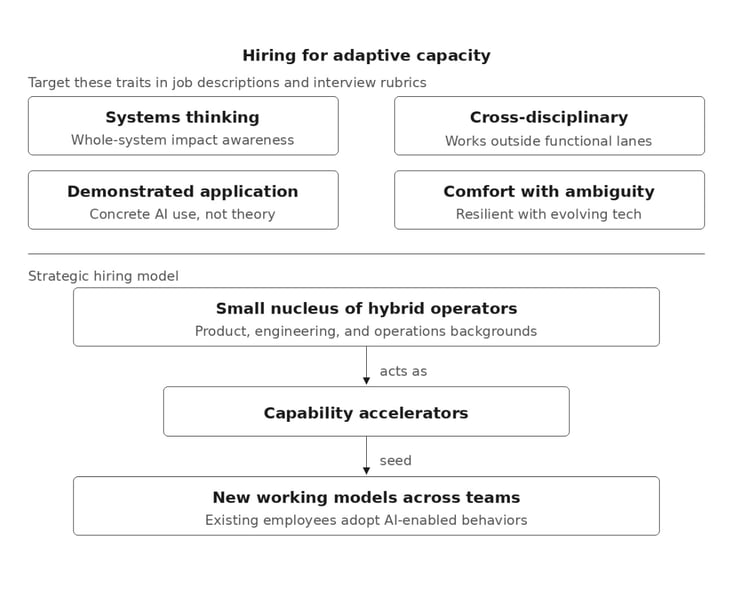
Since the work is changing, the criteria used to recruit people must change alongside it. Traditional hiring criteria (years of experience with a specific software suite, or a rigid degree requirement) are no longer sufficient indicators of success. Organizations increasingly require individuals who demonstrate the ability to navigate complex, shifting systems and apply emerging tools to solve novel operational problems.
When rewriting job descriptions and interview questions, target these desired traits:
Systems Thinking: The ability to see how changing one variable impacts the entire operational ecosystem.
Cross-Disciplinary Collaboration: A track record of working outside narrow functional lanes.
Demonstrated Application: Concrete examples of using AI tools to solve real business problems, not just theoretical knowledge.
Comfort with Ambiguity: The resilience to work effectively with evolving, imperfect technologies.
For an organization to be truly adaptive, HR and Ops teams must move beyond being mere "users" of technology to becoming "builders." However, this requires a structured partnership with IT to ensure scale and security.
We must account for the reality that HR/Ops will create the initial spark. The process follows a clear path:
The Prototype (HR/Ops Led): Using IT-sanctioned low-code platforms, business teams build "functional prototypes" to solve immediate operational friction.
The Productionalization (IT Led): Once a prototype proves its value and requires enterprise-wide deployment or handles sensitive data, IT steps in to "productionalize" the tool: optimizing code, ensuring security compliance, and providing long-term technical support.
Actionable HR Changes: Do not try to hire a massive army of these individuals all at once. Build a small nucleus of hybrid operators with backgrounds spanning product development, engineering, and operations. These individuals will seed new behaviors and help existing teams adopt new working models.
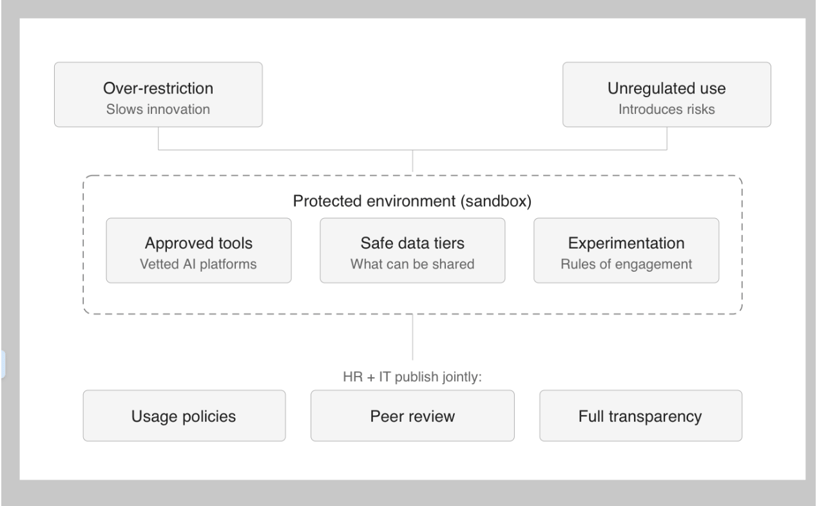
Infrastructure for Innovation: To support this hybrid workforce, IT must transition from a "gatekeeper" to a "Platform Provider." IT provides secure environments (sandboxes) where HR/Ops can experiment safely. The goal is a "build-to-scale" model where innovation happens at the edges, while reliability is maintained at the core by IT professionals.
The final pillar is governance. Effective governance in an AI-integrated ecosystem is a delicate balancing act. Excessive restrictions and heavy-handed IT policies slow experimentation to a crawl. Conversely, unregulated experimentation introduces massive operational, data, and compliance risks.
The most practical model is for HR and IT to jointly create "Protected Environments." This is an approach where boundaries are clear, but freedom within those boundaries is absolute.
The “Protected Environment” Approach:
Define Approved Tools: Specify exactly which AI platforms have been vetted for data security.
Establish Safe Data Environments: Clarify what internal data can be fed into AI models and which is strictly off-limits.
Set Experimentation Guidelines: Outline the rules of engagement so employees can innovate aggressively with organizational oversight.
HR and IT must jointly publish clear usage policies, encourage peer review processes for AI-generated outputs, and require total transparency for any automated decisions that affect customers or employees.
Organizations are operating in environments where technology, competition, and customer expectations are in a state of continuous evolution. Operational systems can only adapt to these conditions if the workforce evolves alongside them.
HR leaders are no longer just administrators of headcount; they are the architects of the organization's adaptive capacity. They play a central role in determining how quickly the organization can learn, experiment, and implement improvements.
Organizations that treat workforce adaptability as strategic infrastructure will capture the massive productivity gains AI makes possible. Those that continue managing talent primarily through static, legacy processes will struggle to translate raw technological capability into operational advantage.
But even the most capable workforce will eventually hit a wall: the corporate 'immune system.' In the next article, we examine how HR must protect innovation through new compensation models and how to ensure external experts actually build internal muscle. Then will we look at how IT leaders must redesign the data platforms that fuel this entire engine.
Your experiences matter: Contact me if you're interested in learning more about the adaptive workplace.