What's on the Shelf? Machine Vision, LLMs, and Modern Shelf Analytics
Walk down any grocery aisle, and you're looking at one of retail's most valuable pieces of real estate, and one of its...


|
AI & DATA STRATEGY
|
 |
|
Synaptiq helps you develop your AI and data strategy as well as accelerate your roadmap to achieve successful business outcomes. Assess your AI and data readiness so you can prioritize the gaps you need to fill.
|
| Read More ⇢ |
|
DATA LAKE
|
 |
|
Synaptiq helps you unify structured and unstructured data into a secure, compliant data lake that powers AI, advanced analytics and real-time decision-making across your business.
|
| Read More ⇢ |
|
AI AGENTS & CHATBOTS
|
 |
|
Synaptiq helps you create AI agents and chatbots that leverage your proprietary data to automate tasks, improve efficiency, and deliver reliable answers within your workflows.
|
| Read More ⇢ |
|
LEGAL SERVICES
|
 |
|
Learn how Synaptiq helped a law firm cut down on administrative hours during a document migration project.
|
| Read the Case Study ⇢ |
|
GOVERNMENT/LEGAL SERVICES
|
 |
|
Learn how Synaptiq helped a government law firm build an AI product to streamline client experiences.
|
| Read the Case Study ⇢ |
 |
|
Mushrooms, Goats, and Machine Learning: What do they all have in common? You may never know unless you get started exploring the fundamentals of Machine Learning with Dr. Tim Oates, Synaptiq's Chief Data Scientist. You can read and visualize his new book in Python, tinker with inputs, and practice machine learning techniques for free. |
| Start Chapter 1 Now ⇢ |

In the first post of this series, we examined why traditional operating models are struggling to keep pace with the current rate of technological and competitive change. The constraint is no longer the availability of technical capability. It is the lack of real-time visibility into how work actually moves through the organization. So if the issue is visibility, how can organizations truly see—and understand—how work flows across their business in real time?
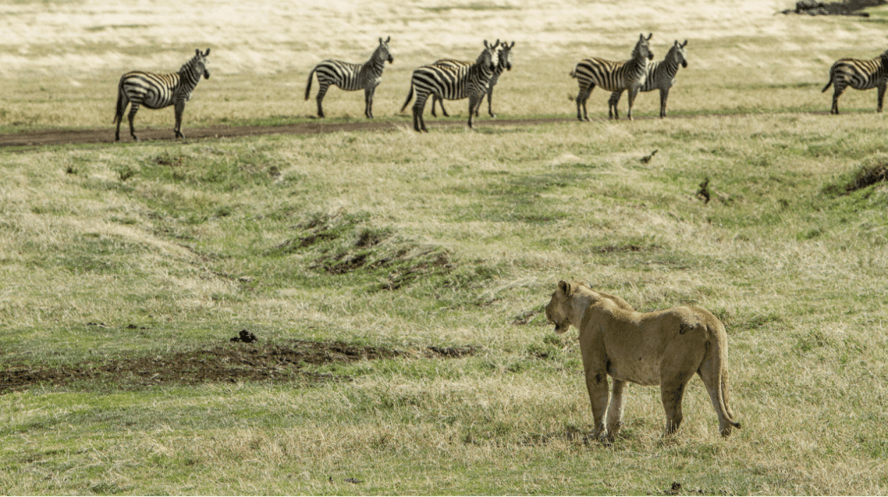
In ecological systems, adaptation begins with sensing. Organisms survive because they continuously register signals from their environment and respond before conditions become fatal. This second article focuses on how to build that sensing capability into the operational core. It examines how to instrument workflows so that every critical activity generates usable data, how to convert that data into actionable signals, and how to establish feedback loops that allow processes to evolve continuously through execution. The goal is to move beyond periodic improvement toward an operating ecosystem that senses, learns, and adapts in real time.
Most organizations lack real visibility into how work actually gets done. Companies still manage operations through summary metrics and periodic reporting rather than real-time execution data. Without direct visibility into execution, improvement remains slow and reactive.
Hyperadaptive organizations operate differently. They treat every workflow as a source of live operational data. Each task, decision, and exception produces signals that can be analyzed and acted on. This continuous flow of information functions as the organization’s operational nervous system. Hyperadaptive operations require a shift from outcome tracking to execution sensing. Every critical workflow should be instrumented to produce usable signals at each step. Instead of waiting for monthly reports, teams must be able to see where friction occurs as work moves through the system.
Every high-impact process should capture:
These signals create a real-time map of operational health. Patterns that were previously invisible become measurable within days.
The following 30- and 90-day roadmap outlines how to move from operational opacity to measurable signals without disrupting core execution.
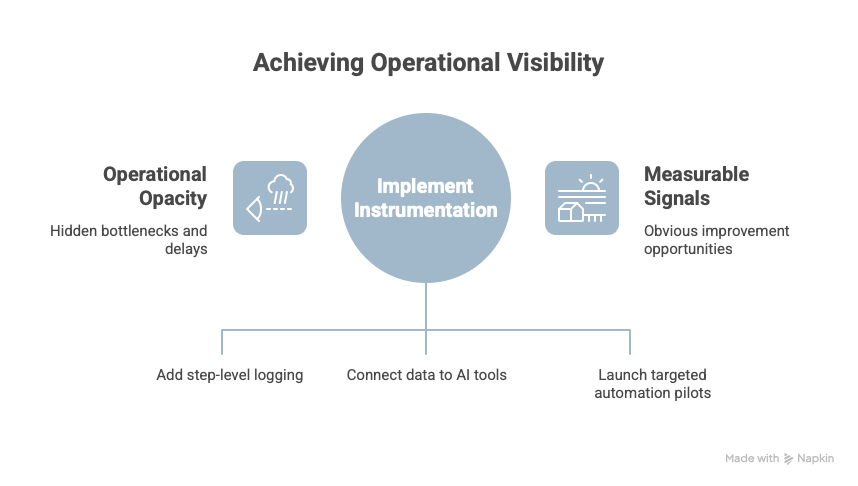
Even basic logging will reveal bottlenecks that were previously hidden.
Once consistent data begins to flow, improvement opportunities become clearer. Teams can shift from debating where problems exist to measuring them directly.
This operational nervous system is the foundation of hyperadaptability. Organizations that build it can evolve processes steadily without waiting for formal transformation programs.
The goal of instrumentation is more than just improved reporting; it is the creation of a high-fidelity feedback loop that exposes hidden friction and quantifies the cost of manual workarounds. You can move your operation from a “dark” system to a sensory-enabled environment.
Knowing where you are failing is useless without the ability to fundamentally re-architect how the work is performed. With a clearer operational nervous system in place, organizations are prepared to move from observation to active evolution.
In Part 3 of this series, we will double down on process design, shifting your focus from monitoring the status quo to orchestrating a human–AI collaborative engine.
At Synaptiq, we help organizations redesign workflows, build data visibility into operations, and implement AI-driven systems that enable continuous adaptation. If your organization is exploring how to evolve its operating model in the age of AI, contact us to learn how Synaptiq can help.