From Answers to Action with Enterprise AI Agents: Webinar Recap
Chatbots can tell you your churn rate. In contrast, enterprise AI agents can find the accounts at risk, work out why,...


|
AI & DATA STRATEGY
|
 |
|
Synaptiq helps you develop your AI and data strategy as well as accelerate your roadmap to achieve successful business outcomes. Assess your AI and data readiness so you can prioritize the gaps you need to fill.
|
| Read More ⇢ |
|
DATA LAKE
|
 |
|
Synaptiq helps you unify structured and unstructured data into a secure, compliant data lake that powers AI, advanced analytics and real-time decision-making across your business.
|
| Read More ⇢ |
|
AI AGENTS & CHATBOTS
|
 |
|
Synaptiq helps you create AI agents and chatbots that leverage your proprietary data to automate tasks, improve efficiency, and deliver reliable answers within your workflows.
|
| Read More ⇢ |
|
LEGAL SERVICES
|
 |
|
Learn how Synaptiq helped a law firm cut down on administrative hours during a document migration project.
|
| Read the Case Study ⇢ |
|
GOVERNMENT/LEGAL SERVICES
|
 |
|
Learn how Synaptiq helped a government law firm build an AI product to streamline client experiences.
|
| Read the Case Study ⇢ |
 |
|
Mushrooms, Goats, and Machine Learning: What do they all have in common? You may never know unless you get started exploring the fundamentals of Machine Learning with Dr. Tim Oates, Synaptiq's Chief Data Scientist. You can read and visualize his new book in Python, tinker with inputs, and practice machine learning techniques for free. |
| Start Chapter 1 Now ⇢ |


Chatbots can tell you your churn rate. In contrast, enterprise AI agents can find the accounts at risk, work out why, and execute the next step.
In a recent Synaptiq webinar, Dr. Tim Oates, Co-founder and Chief Data Scientist, explained how enterprise AI agents operate, how companies can integrate them, and why data governance and guardrails are what make them trustworthy. For most organizations, the difficulty isn't making AI smarter, but connecting enterprise data to enterprise work, safely.
Dr. Oates framed the shift as a progression, using an example of a company concerned about losing their customers:
AI agents are moving fast. Citing Gartner, Dr. Oates noted that internal deployment is increasing and that 42% of enterprise tech leaders already have agents in production. Gartner also projects the share of companies using task-specific agents will grow from under 5% to 40%.
The gap between experimenting and delivering remains wide. Nearly two-thirds of enterprises have experimented with agents, yet fewer than 10% have taken them to tangible value.
The good news is that AI agents are now practical to build and run. Dr. Oates pointed to four developments that have come together to make this happen:
Together, these developments let AI move beyond analysis and into the work itself. A problem, however, still stands in the way.
Dr. Oates went on to describe what he calls the last mile problem.
Today, it’s common for companies to extract information from data sources, build pipelines, centralize this information in a lakehouse, and build analytics and machine learning. Then a human is required to turn insights into action.
AI agents provide action. They identify the affected customers, investigate the underlying causes, review recent support interactions, recommend interventions, draft outreach, create CRM tasks, and escalate unusual cases when necessary. So, how do we ensure the AI agents are turning insights into the correct actions?
An AI agent is more than a model. It is the system built around the model, which serves as its reasoning engine. An enterprise AI agent combines four core components:
AI agents don't just answer; they iterate. The result of one action becomes the input to the next decision. For example, a churn agent might find at-risk accounts, check their history, and retrieve the relevant policy before making a recommendation.
Although AI agents can act, that doesn’t mean that they have to act without oversight. Dr. Oates was clear that autonomy is a dial, not a switch. There are several levels of autonomy that can be granted depending on the guardrails in place:
High-stakes tasks that demand a lot of reasoning should keep a human involved. Human-in-the-loop (HITL) is not all or nothing; it's a workflow design decision.
While it’s true that enterprise AI agents add value by taking on more autonomy, it’s important to acknowledge the constraints that keep that autonomy safe, accountable, and within defined boundaries. Dr. Oates highlighted five questions every organization should be able to answer:
Building the agent is the easy part. Building one you trust inside the enterprise is much harder.
Building an AI demo is easy. A demo has one user, one data source, one tool, a happy-path prompt, and manual oversight. An enterprise deployment, by contrast, has many users, many data sources, permissions, multiple tools, failures and edge cases, auditing, cost, and compliance, all of which create challenges.
Dr. Oates described this as a stack of problems rather than a single one, so teams need to evaluate every level for weaknesses. Common failure points include:
Dr. Oates also traced how the stakes rise as systems get more capable, from traditional analytics to agentic AI. More autonomy means a greater need for trusted data.
That's why a firm data foundation has to come first. It's also why guardrails belong at every layer, with evaluation, tracing, and monitoring running across all of them:
|
Layer |
Guardrail |
|
User Request |
Identity & Permissions |
|
Agent Reasoning |
Policy checks, logging, tracing |
|
Data Access |
Approved sources, row & column permissions |
|
Tool Use |
Tool allowlists and approval gates |
|
Business Action |
Threshold rules & human approval |
The principle running through all of it: never rely on the model itself to enforce the rules that constrain the model.
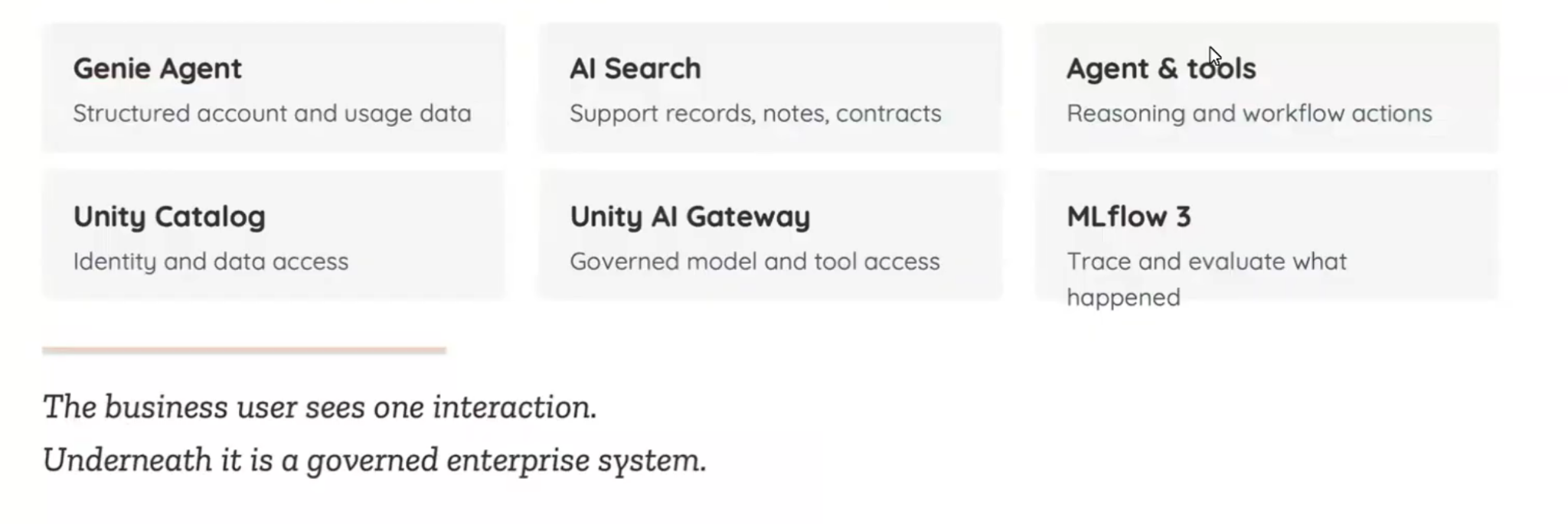
Dr. Oates's approach is to start with governed data and build the AI platform on top of it, rather than moving data over to an AI stack. Databricks supplies the infrastructure around the AI agent, though not how the agent itself reasons. The key pieces he walked through are outlined below.
AI agents need both structured and unstructured knowledge. Databricks Genie agents handle structured data such as customers, transactions, usage, and financials. AI Search handles unstructured knowledge such as policies, contracts, support tickets, and documents.
Genie isn't just a chatbot; it's a tool that becomes part of a larger enterprise agent.
MCP is a standard way for an AI agent to discover and invoke tools. It lets a system say, "Here's what's out there, here's the input I need, and here's the output you'll get back," so different platforms can communicate. Databricks provides managed MCP servers for:
AI agents can then reach enterprise systems such as CRM, Slack, Drive, APIs, and custom apps. Knowledge makes an agent useful; tools let it take action.
The churn agent, for example, pulls metrics from a Genie agent, supports records from AI Search, then pricing from a governed function, and writes to the CRM.
Every request from an AI agent passes through the Unity AI Gateway on its way to models, tools, and MCP services, carrying identity and permissions from the Unity Catalog. The gateway covers four areas:
The enforcement point sits outside the model, which is the whole idea. You can tell an AI agent it may only answer HR questions, preventing the agent from overreaching and answering questions outside of its governed scope.
MLflow 3 for GenAI captures prompts, model calls, intermediate steps, tool calls, outputs, latency, evaluation scores, and human feedback. That supports a continuous loop: evaluate, improve, deploy, monitor. If a prompt isn't working well, you can improve it, redeploy, and keep watching. As Dr. Oates put it, observability is part of correctness.
The full stack runs from enterprise data in the lakehouse and Delta tables, up through the catalog (what data you can access), models, agents and multi-agent systems, the gateway (what an agent can do), and MLflow 3 (measuring everything). To put agents in front of people, Databricks offers an AI Playground for prototyping, an agent SDK that works with tools like OpenAI and LangGraph, and Databricks Apps for hosting experiences people can log in to. Synaptiq has built several of these.
The through line: data → knowledge → models → tools → agents → applications, with governance and evaluation carried throughout.
Dr. Oates closed the demonstration with one example question that carries a lot of enterprise context: "Which customers are most at risk of churn this quarter, and what should we do about them?"
Answering it takes revenue and account history, product usage, support tickets, contracts, renewal dates, and company policies. No single database contains the answer.
This is a business investigation, not a generated answer.
Consider this request: "Prepare a renewal offer with a 20% discount and send it to the customer." Company policy says account managers may approve up to 10%, and anything above 10% requires VP approval.
The agent drafted the renewal offer and prepared the approval request, but it did not send anything to the customer. That is autonomy within defined boundaries.
One interaction used many Databricks capabilities, such as investigation, recommendation, action preparation, and escalation. AI brought the data to an outcome much more quickly, with the guardrails intact.
Dr. Oates closed with four ideas to carry forward:
1. AI agents act; they don't just answer. They bring some degree of governable autonomy to enterprise work.
2. An AI agent is a system, not a model. An LLM is a key part of an agent, providing natural language interaction and the ability to reason. But an agent also needs data, tools, and a control loop, and the amount of autonomy allowed is up to you.
3. The challenge is trust, not intelligence. Models are now so capable that intelligence comes more easily. Trust is the hard part. AI agents can't be relied on to behave on their own, so trust has to be enforced through mechanisms like Databricks Unity Catalog.
4. Put the AI agent where governed data already lives. Build the AI stack on top of your data rather than moving data over to the AI stack for the best results.
The AI ecosystem is complicated and evolving quickly. An experienced partner can help your organization move fast while building the trust that enterprise agents require.
Interested in how your organization can put enterprise AI agents to work? Reach out to Synaptiq to learn how building AI agents on governed data in Databricks can drive measurable business outcomes.