What's on the Shelf? Machine Vision, LLMs, and Modern Shelf Analytics
Walk down any grocery aisle, and you're looking at one of retail's most valuable pieces of real estate, and one of its...


|
AI & DATA STRATEGY
|
 |
|
Synaptiq helps you develop your AI and data strategy as well as accelerate your roadmap to achieve successful business outcomes. Assess your AI and data readiness so you can prioritize the gaps you need to fill.
|
| Read More ⇢ |
|
DATA LAKE
|
 |
|
Synaptiq helps you unify structured and unstructured data into a secure, compliant data lake that powers AI, advanced analytics and real-time decision-making across your business.
|
| Read More ⇢ |
|
AI AGENTS & CHATBOTS
|
 |
|
Synaptiq helps you create AI agents and chatbots that leverage your proprietary data to automate tasks, improve efficiency, and deliver reliable answers within your workflows.
|
| Read More ⇢ |
|
LEGAL SERVICES
|
 |
|
Learn how Synaptiq helped a law firm cut down on administrative hours during a document migration project.
|
| Read the Case Study ⇢ |
|
GOVERNMENT/LEGAL SERVICES
|
 |
|
Learn how Synaptiq helped a government law firm build an AI product to streamline client experiences.
|
| Read the Case Study ⇢ |
 |
|
Mushrooms, Goats, and Machine Learning: What do they all have in common? You may never know unless you get started exploring the fundamentals of Machine Learning with Dr. Tim Oates, Synaptiq's Chief Data Scientist. You can read and visualize his new book in Python, tinker with inputs, and practice machine learning techniques for free. |
| Start Chapter 1 Now ⇢ |

%20(1)-1.jpg?width=1080&height=992&name=Untitled%20design%20(57)%20(1)-1.jpg)
In a previous Synaptiq webinar, Dr. Tim Oates, Co-founder and Chief Data Scientist, walked through how AI is showing up across the food and beverage industry, from menus and grocery store shelves to flavors and production lines.
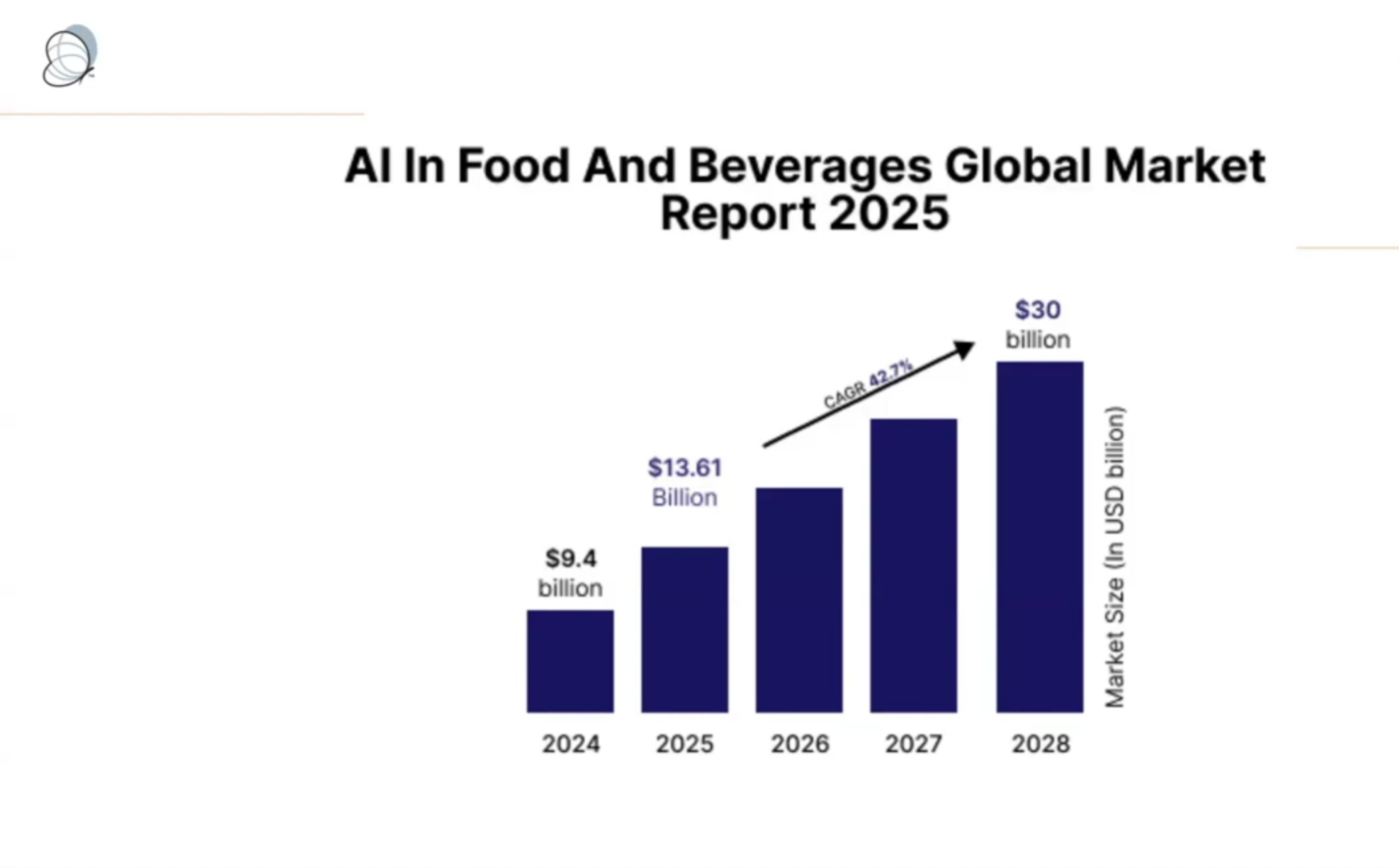
Global AI investment in food and beverage hit $13.6 billion in 2025 and is on pace to more than double to $30 billion by 2028. Few industries have this much untapped AI potential to capitalize on.
Four applications stood out from the webinar:
Dr. Oates leaned on a handful of real projects Synaptiq has worked on, then revisited two of these projects with a twist: what happens if you hand the same problem to a Large Language Model (LLM) today? The results were a useful reminder of both how far the technology has come and where it still falls short.
Let’s dive in.
Imagine you're a food distributor selling produce to hundreds of restaurants. You know exactly how much fruit one client buys from you — but you have no idea if they're also buying vegetables from a competitor down the street, or what else is on their shopping list. That blind spot is where a lot of missed revenue hides.
Restaurant menus are full of information about ingredients, quantities, and prices. Scraping menus at scale allows a food supplier to learn more about the dishes a particular restaurant offers — not only relating to which ingredients they must buy, but also in what quantity.
A food supplier that sells cases of ingredients to restaurants came to Synaptiq with a scale problem, one that's common to distributors: How can suppliers increase their sales volume to each restaurant they serve?
Synaptiq treated this as an object detection problem, building a model to draw boxes around individual menu items, then pulling the dish name, price, and ingredient list out of each one. This was harder than it sounds. Menus vary wildly in layout and font; they're usually images rather than clean text, and Optical Character Recognition (OCR) mistakes are common.
The team compensated with background knowledge: known ingredient lists, typical price ranges, and cuisine type all helped the system correct itself. Raw menus were also stored in a database rather than discarded, so the extraction models could be rerun and improved later without re-scraping the web.
Dr. Oates then revisited the problem with ChatGPT. When asked broadly to extract dishes from a link, the model confidently listed items that weren't on the menu at all, including a "mixed pakora with homemade spiced onions" that appeared nowhere on the actual page. When prompted in a more specific follow-up query, with the menu content directly in front of it, ChatGPT did a strong job identifying dishes, prices, and ingredients, and could answer natural follow-up questions about a specific item, correctly pricing the American Cheese Steak at $11.99 and listing its ingredients.
The lesson: general-purpose LLMs can get you most of the way there quickly, but broad prompts invite confident wrong answers, meaning the results need to be checked by a human.
Machine vision allows companies to analyze products on grocery store shelves, an area Synaptiq has explored with a few different companies, and one that's gotten a boost recently from autonomous aisle-scanning robots.
Shelf analytics provide value for organizations in many ways:
There are also challenges to shelf analytics, such as the many variants of the same product, nearly identical packaging across flavors, items put back in the wrong spot by shoppers, products partially out of view, different sizing options of the same product, and the enormous number of SKUs a system has to recognize.
Synaptiq's approach again used object detection, but with a technique called few-shot learning: instead of needing hundreds of labeled examples of each product, the model learns to recognize an item from something like a single manufacturer photo. Domain knowledge did a lot of work here too. Similar products tend to cluster together on a shelf, and unexpected color changes as you scan across a row are a good signal that something's out of place. A human in the loop to catch and correct mistakes remained essential.
Dr. Oates ran a version of this through ChatGPT as well. The model could describe what was on the shelf and even locate a specific product, but it undercounted the number of bags present (seven instead of eight) and struggled to correctly identify which shelf they were placed on.
His takeaway mirrors the menu example: at first glance, the LLM capability looks remarkable, but looking closer reveals real issues, and the mistakes tend to be subtle, hard to find, and even harder to fix once they're baked into a downstream process.
Subtle counting and spatial errors like these are easy to miss at scale, which is why Dr. Oates recommends a trust-but-verify approach layered with more deliberate prompting: start with an initial prompt, then ask the LLM to verify its own results, and for anything higher-stakes, ask a second, different LLM to corroborate the first one's answer.
The next two examples take a different shape. Rather than testing today's LLMs against a task, they show what's already possible when machine learning is purpose-built for a hard, narrow problem.
Machine learning has been applied to predicting and improving complex beer flavors, as cited in the Nature Communications journal.
Researchers in Belgium gathered detailed chemical data on 250 commercial Belgian beers spanning 22 different styles. Data included alcohol content, pH, sugar concentration, the concentration of over 200 flavor-related compounds, as well as many other features.
They paired the quantitative data with a 16-person taste panel sampling and scoring each beer across 50 different attributes, such as hop flavor, sweetness, and acidity, plus roughly 180,000 reviews pulled from the online consumer review platform, RateBeer.
This is a great example of supervised learning in action — things such as chemical properties of beer are labeled by type, information is extracted about them, and then this information is handed to a computer program to make a prediction.
Once this model exists, it opens the door to flavor simulation. Researchers can nudge a single variable input, say, raising the pH slightly, run it back through the model, and see whether the predicted score improves, without brewing a single new batch.
Let’s say a particular beer characterized by x chemical properties was rated a 7.5/10 by a beer review site. This score of 7.5/10 allows for flavor simulation and improvement, raising questions such as: What variables can I tweak to improve taste?
This process allows for continual refinement and complements a brewer’s expertise.
The applications extend well beyond beer:
Notably, the researchers were careful to point out that the brewer's skills matter. AI can be a serious force multiplier, but it is not a replacement for the person doing the crafting and tasting.
Predictive maintenance is a common application across manufacturing-heavy industries such as construction, so it should come as no surprise that predictive maintenance carries particular weight in food and beverage as well.
Maintenance falls under three main categories: preventative, reactive, and predictive — so what is the difference?
Preventative maintenance entails routine upkeep regardless of condition (no signals, no critical need, but you do it anyway). Reactive maintenance involves fixing something after it's already broken. Predictive maintenance catches the subtler signals in between, things like vibration, ultrasound, and infrared, and it does so well before the equipment is audibly or visibly failing.
Predictive maintenance is super important in the food and beverage industry due to:
High-speed production lines wear down faster the harder they run. Customers expect the same product to taste identical batch after batch, so consistency isn't optional. Regulatory compliance, specifically following Good Manufacturing Practice (GMP) and Food Safety Modernization Act (FSMA) requirements, is non-negotiable. Constant cleaning and sanitation exposes equipment to water and chemicals that cause corrosion. Critical equipment like chillers, mixers, and HVAC systems are crucial to production; when these systems fail, raw materials are wasted, downtime goes up, and costs rise.
Synaptiq worked on a past project involving a data acquisition system logging binary sensor values every millisecond from equipment switches. A clean transition from open to closed was ‘normal’. Meanwhile, ‘chatter’, rapid flickering before the switch fully transitioned, signaled a developing problem. That distinction could be learned either through supervised learning, where experts label good and bad readings, or through anomaly detection, comparing new readings against what normal operation typically looks like.
If there's someone on the floor who's worked with a piece of equipment long enough to sense when something's off, there's a good chance you can build a system to do the same thing.
Some defects, like faults in concrete, are detectable with infrared sensors, yet invisible to the human eye. Either way, three considerations remain crucial:
Feasibility — could an educated professional with many years of equipment experience complete the needed tasks — what information would that person use or need?
Return on investment (ROI) — what are the costs of downtime, instrumentation, data storage, and the expected increase in uptime?
Approach — which strategy fits the problem: anomaly detection, supervised learning, data visualization, or another?
Food and beverage manufacturing is an open field for AI right now, and it's not limited to what's covered here. Inventory management, waste reduction, supply chain visibility, and quality assurance all possess great potential for optimization.
The best place to begin:
Interested in exploring what AI could do for your food and beverage operation? Reach out to Synaptiq to learn more about putting your data to work.