From Theory to Practice: How to Build AI Agents
AI adoption is happening fast. Many leaders across industries are finding new and creative ways to integrate AI agents...


|
AI & DATA STRATEGY
|
 |
|
Synaptiq helps you develop your AI and data strategy as well as accelerate your roadmap to achieve successful business outcomes. Assess your AI and data readiness so you can prioritize the gaps you need to fill.
|
| Read More ⇢ |
|
DATA LAKE
|
 |
|
Synaptiq helps you unify structured and unstructured data into a secure, compliant data lake that powers AI, advanced analytics and real-time decision-making across your business.
|
| Read More ⇢ |
|
AI AGENTS & CHATBOTS
|
 |
|
Synaptiq helps you create AI agents and chatbots that leverage your proprietary data to automate tasks, improve efficiency, and deliver reliable answers within your workflows.
|
| Read More ⇢ |
|
LEGAL SERVICES
|
 |
|
Learn how Synaptiq helped a law firm cut down on administrative hours during a document migration project.
|
| Read the Case Study ⇢ |
|
GOVERNMENT/LEGAL SERVICES
|
 |
|
Learn how Synaptiq helped a government law firm build an AI product to streamline client experiences.
|
| Read the Case Study ⇢ |
 |
|
Mushrooms, Goats, and Machine Learning: What do they all have in common? You may never know unless you get started exploring the fundamentals of Machine Learning with Dr. Tim Oates, Synaptiq's Chief Data Scientist. You can read and visualize his new book in Python, tinker with inputs, and practice machine learning techniques for free. |
| Start Chapter 1 Now ⇢ |

%20(1).jpg?width=1080&height=992&name=Untitled%20design%20(38)%20(1).jpg)
If AI is a rocket, data is the fuel that propels it. For most organizations, the challenge isn't a shortage of data but rather completing the AI value chain, from raw information to measurable outcomes.
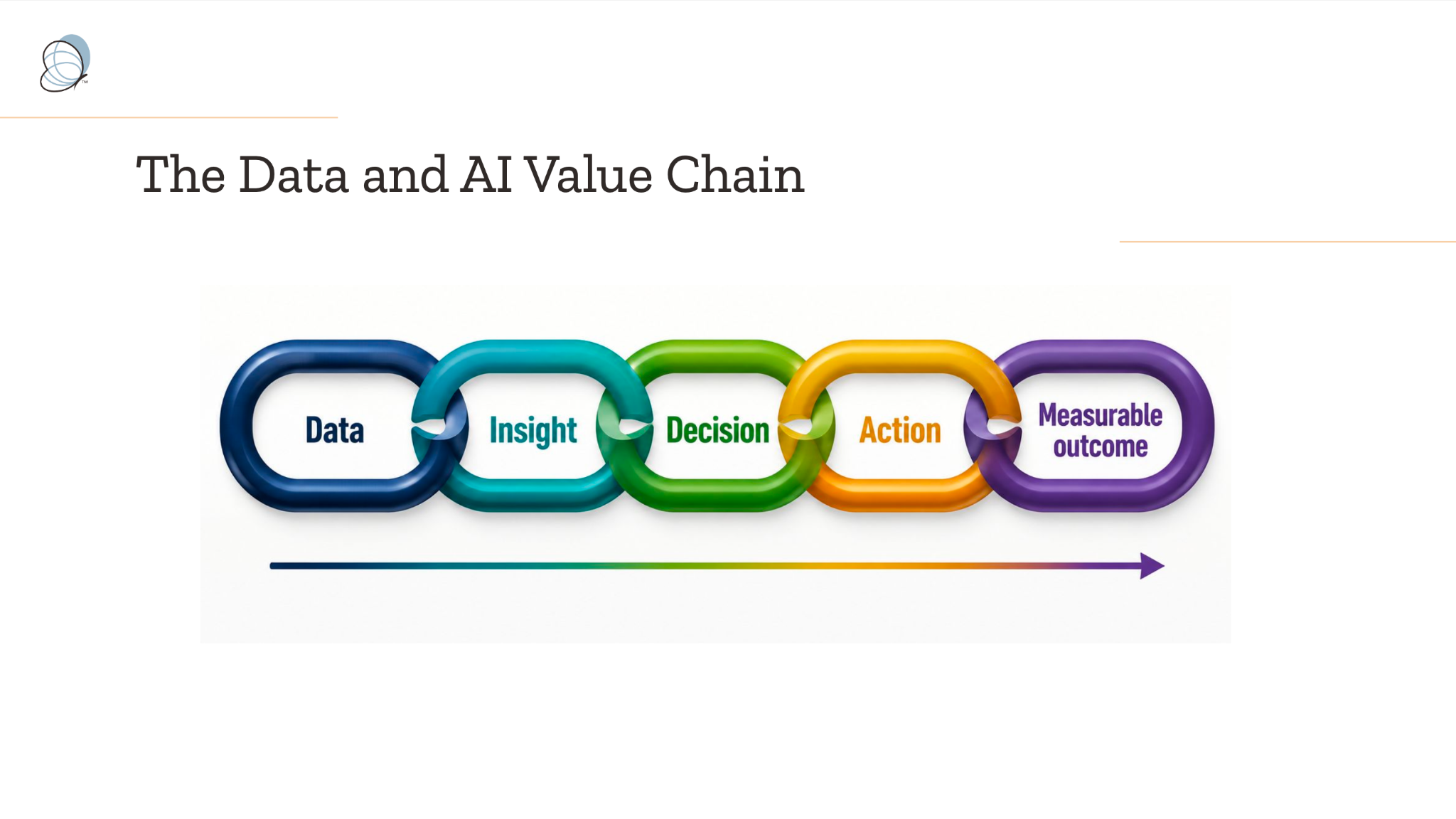
In a recent Synaptiq webinar, Dr. Tim Oates, Co-founder and Chief Data Scientist, walked through 10 ways companies are turning data into insights and faster decisions. The result: more efficient AI implementation and a higher return on their data investment.
Dr. Oates opened with striking findings from Cloudera's 2026 Data Readiness Index. When employees were asked if they have visibility into where their organization's data is stored, responses varied wildly by industry. For instance, 89% of telecommunications respondents said yes, public sector organizations were far less confident at 66%, and many other industries fell somewhere in between.
Knowing where your data is, and being able to actually use it, are two different problems. For this talk, Dr. Oates focused on the following: assuming your data is usable, what can you actually do with it?
Across sectors, data plays 4 unique roles for businesses:
Here’s the recap.
Modern AI is democratizing access to data. Instead of routing every question through an IT team, people can now talk directly to a database or spreadsheet in plain English — a sales leader asking which regions missed quota, or a supply chain manager asking which suppliers were late and what products were impacted.
A Gartner survey cited in the talk found that 50% or more of organizations are already doing this.
Previously, this process required submitting a ticket, waiting for a report, and starting the whole process over if you wanted to tweak it — which meant a lot of questions simply never got asked.
With conversational analytics, anyone can ask a question, get a chart back, and easily follow up, which encourages actual exploration of the data.
Dr. Oates noted the effort involved scales with ambition. A single person with access to a Structured Query Language (SQL) database or spreadsheet can get this running in minutes using a tool like Claude Code, while making it available across an organization means building real infrastructure — Model Context Protocol (MCP) servers, agents that know where the data lives, and Large Language Models (LLMs) wired into the mix.
A McKinsey report cited in the talk points to real-world results such as 65% fewer stockouts and lower forecast error when AI powers demand forecasting.
The traditional approach often came down to a longtime employee reviewing last year's spreadsheets and making a judgment call — which meant carrying extra buffer stock to cover the guesswork.
With data at work, SKU-level forecasts can refresh weekly through a lightweight computational process, shrinking the margin for error.
Synaptiq worked with a restaurant group predicting demand for raw ingredients using foot-traffic data derived from cell phone pings; energy providers use similar approaches to anticipate demand spikes and plan generation capacity.
Critically, Dr. Oates emphasized that the forecast has to arrive before the decision it's meant to influence actually needs to be made.
This is the sweet spot between preventative maintenance (routine, scheduled upkeep regardless of condition) and outright failure (audible noise, smell, or heat that tells you something's already broken).
Predictive maintenance looks for subtle signals in between — vibration you can't hear but can sense with ultrasound, or a temperature sensor picking up on something running slightly hot.
Synaptiq built a system for an amusement park operator whose rides were controlled by hundreds of binary switches. Clean transitions between open and closed were classified "normal", while "chatter" — rapid flickering between states — signaled a developing problem.
Detecting a risk is only the first step. The team also had to fit repairs into a maintenance window, confirm parts were on hand, and plan the fix — all before the ride actually failed.
The signal has to be early enough to act on, specific enough to avoid false positives, and worth the cost-benefit tradeoff of intervening early.
A 2021 McKinsey report found that personalization can drive up to 40% more revenue at fast-growing companies.
Personalization runs on a spectrum from coarse to fine:
Synaptiq built personalized recommendation capabilities for a company that provided employee training videos to other businesses, surfacing additional content based on what a company's employees had already watched.
A churn model is a data tool used to identify which customers are likely to leave, and why, allowing companies to intervene effectively. A subscription business may use this tool to reach out to at-risk accounts with strong offers weeks before renewal, in an effort to retain customers.
Dr. Oates pointed out that many companies get this wrong by treating every customer the same. Any company can send out a standard renewal notice to everyone six months in advance, but a retention-focused approach analyzes how likely each customer is to renew and then acts accordingly.
The goal is shifting from a reactive posture, such as attempting to win back customers after they’ve left, to proactively targeting at-risk accounts and providing solutions before they churn.
Dynamic pricing models set prices based on real-time demand, available supply, how likely customers are to respond to a given price, and fairness, rather than a single static rate.
Types of pricing intelligence:
The goal isn't always to charge the highest price the market will bear.
Companies must consider the impact prices will have on individuals by weighing long-term customer relationships, encouraging repeat business, accounting for excess inventory and smoothing demand over time, and most importantly, being able to justify the price as fair. Individualized pricing tends to carry the most reputational risk of the 4 approaches above.
A well-known example of dynamic pricing (demand-based) is Uber's surge pricing: when demand spikes, say after a sporting event, prices rise accordingly.
Ultimately, it’s about optimizing value without sacrificing trust of customers. The smartest pricing system balances today's margin with tomorrow's customer relationship.
Fraud detection models learn what normal behavior looks like and flag anomalies, balancing several competing goals at once: catching fraud, approving legitimate transactions, keeping the process fast, and minimizing how often people have to get involved.
Most fraud systems route decisions probabilistically, meaning that low-risk transactions get approved automatically, uncertain transactions get flagged for a second review, and high-risk transactions get blocked outright and are escalated to a human for further review.
Machine vision acts as a visual inspector, useful anywhere a human would otherwise be watching a conveyor belt or worksite and would be prone to fatigue-driven errors. It can catch micro-defects invisible to the human eye, including ones detectable through heat signatures in materials such as concrete.
These vision models inspect every unit consistently, automatically passing clear cases and flagging defects or uncertainty for further inspection and action.
Machine vision is being applied across industries, ranging anywhere from healthcare to construction solutions.
Synaptiq built a system to assess central-line dressing compliance in hospitals, training a model on clean, compliant dressings and known problem cases as labeled by doctors, then deploying it as a mobile app to help catch a common and dangerous source of bloodstream infections.
Another application is safety compliance for construction sites. Loading and unloading of materials is one of the more dangerous moments on site, which is a concern that machine vision can help address.
Our team built a machine vision model for construction to track how many workers were present and whether they were wearing required Personal Protective Equipment like helmets and high-visibility vests.
One of the most common uses of large language models today is converting unstructured documents into usable insights. Models read invoices, claims, contracts, applications, and forms to extract the information needed to move work forward.
A typical pipeline for turning paperwork into data is as follows:
Receive document → categorize document → extract information → validate information → route
Routing varies on a case-by-case basis. Complete paperwork goes straight through to processing. However, incomplete documents result in requests for additional information, and for especially ambiguous or high-risk cases, they are flagged for human review.
Synaptiq built a system like this using intelligent automation for an immigration law firm working with large tech employers hiring foreign nationals, a process historically bogged down by slow, manual paperwork exchanged with the federal government. Clients uploaded large volumes of supporting documents, which previously required staff to manually verify and label each one.
The new system automatically classified candidates' documents and government forms using machine vision and machine learning, deployed as a managed platform combining a Databricks data lake, OCR, machine vision, language models, and APIs.
Attorneys went from manually processing paperwork to simply scanning and confirming the system’s classifications — saving hours and freeing them up to focus on more complicated legal matters.
Large language models grounded in a company's approved internal sources can find information, synthesize answers, and help employees complete tasks, all with citations and permissions preserved.
Take HVAC field service as an example. When a technician is dispatched to diagnose a problem, they may not have the right part on hand, meaning a second truck has to be sent out at real cost in time and money.
However, with AI-enabled recommendations based on the site, AC system model and age, and historical repair records, likely failure points can be anticipated.
This reflects a broader arc, from search to action:
Dr. Oates noted this kind of system helps newer staff get productive faster too, since they're getting direct answers instead of digging through undifferentiated documentation.
Throughout this webinar, we've introduced a variety of implementations across different industries, all using the same playbook. Dr. Oates closed with three takeaways that tie all 10 examples together:
1. Start with a decision, not a dataset.
Begin with the decision you want to change or improve, and work backward to figure out which data supports that decision.
2. A solid data foundation is key.
Models themselves are increasingly a commodity — problems that once required custom-built vision models a decade ago can now often be handed to an off-the-shelf language or vision model. What makes an organization distinctive is whether its data is trustworthy, connected, and governed.
3. Value comes from adoption.
A proof of concept that never gets integrated into existing workflows is worthless, no matter how accurate the underlying model is. A 99%-accurate model that nobody uses delivers nothing — design for the workflow, not just the metric.
Interested in how your organization can put its data to work? Reach out to Synaptiq to learn more about unlocking and leveraging your data to drive measurable business outcomes.